
Walking is a way of life round here. The village is shot through with footpaths, which are much beloved of dog walkers. Most of the roads don’t have pavements, or indeed streetlights, but people aren’t put off, and walk the roads, to go to the pub, the church, visit their friends, or simply for the pleasure of it.
And there’s much to entice you outside: the majestic oak trees that line seemingly every field and road; the beech wood with its under-carpet of bluebells; the narrow lanes where you are more likely to see a cyclist or horse rider than a car; and the grounds of the local manor house, from where you can see for miles.
Having to re-learn to walk two years ago following catastrophic illness, I joined the ranks of the walkers, because walking was then impossible and I was grittily determined to regain the skill and strength. Then, when strength returned, I continued for the soul-uplifting pleasure of it.
Now, every week I’ll take you on a local walk and tell you about the highlights. I hope you enjoy it as much as I do.
Too many chocolates had been eaten
It was Betwixtmas. Too many chocolates had been eaten. There had been too much emotional jelly and ice cream. I was done for and slumped on the sofa on a grey afternoon. At 3pm the light was fading, and I knew that this simply wouldn’t do, so headed out on a walk that takes you away from the village, past the Manor and out quickly into farmland. It was silent.
Presumably everyone else was on their sofa, still tucking into the chocolates.
There was nothing about the afternoon that beckoned. The grey, leaden sky leant a cheerless feel to the day.
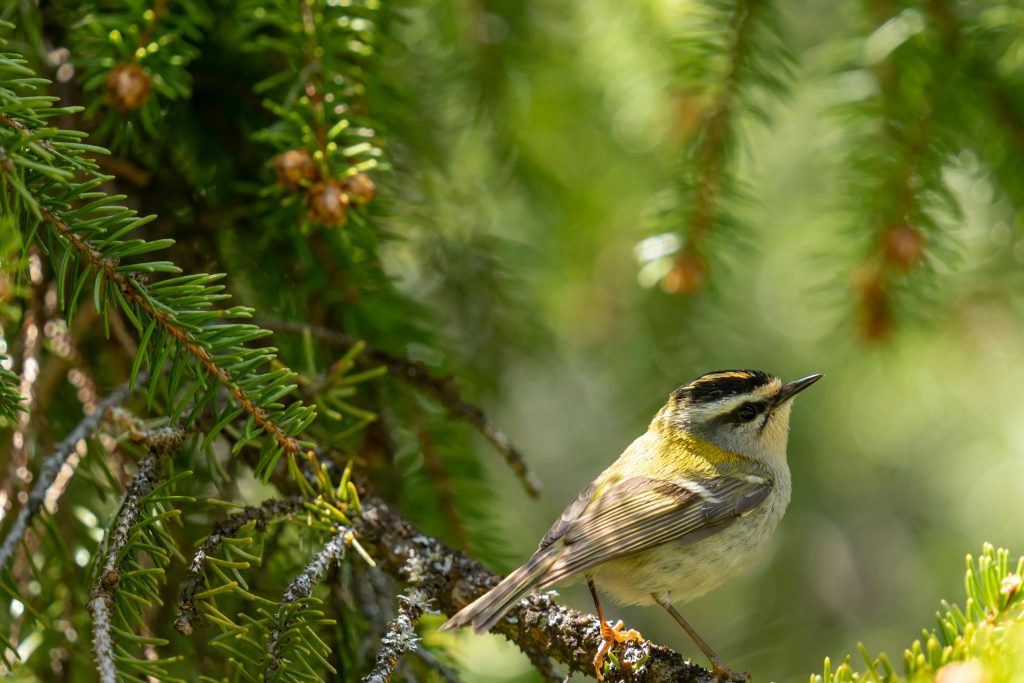
But as I rounded the corner for home, up a very narrow footpath, a glimmer of orange caught my eye: a firecrest, flitting about its busy life in the hedgerow.
A firecrest! It vies for the title of Britain’s smallest bird with the goldcrest, weighing in at just 5.4g.
But with its vivid orange miniature mohican it is a show stopper.
However, the show is seldom stopped. The firecrest was first known to breed in Britain as recently as 1962. It is still rare, with an estimated 2-4,000 breeding pairs in the country, its numbers boosted at this time of year by some migratory chums.
It lives in deciduous woodland, but is quite happy to seek insects in and around hedgerows, which is exactly what it was doing when I came upon it.
Was it a unicorn?
In my 61 years, I’ve seen one goldcrest, and they are far more populous than the firecrest, but still considered hard to see because of their natural shyness. But until this moment, I had never seen a firecrest. Then, there it was, lighting up the gloom with its orange, white, green and yellow plumage, like a flying coat button, hopping and pottering around the narrow hedge in search of its afternoon tea.
Horses live on that corner, so the chances of there being a few flies around seemed quite high. But if I’d come face-to-face with a unicorn I couldn’t have been more surprised.
I stopped, offered it the respect it deserved and waited for it to take its time. The hedgerow, after all, is its home, not mine. It flitted into denser undergrowth and I walked home, agog. It was a lesson, if one were needed, in the unexpected benefits of getting up off the sofa and giving myself the chance of seeing the totally spectacular. A lesson for life, methinks.