
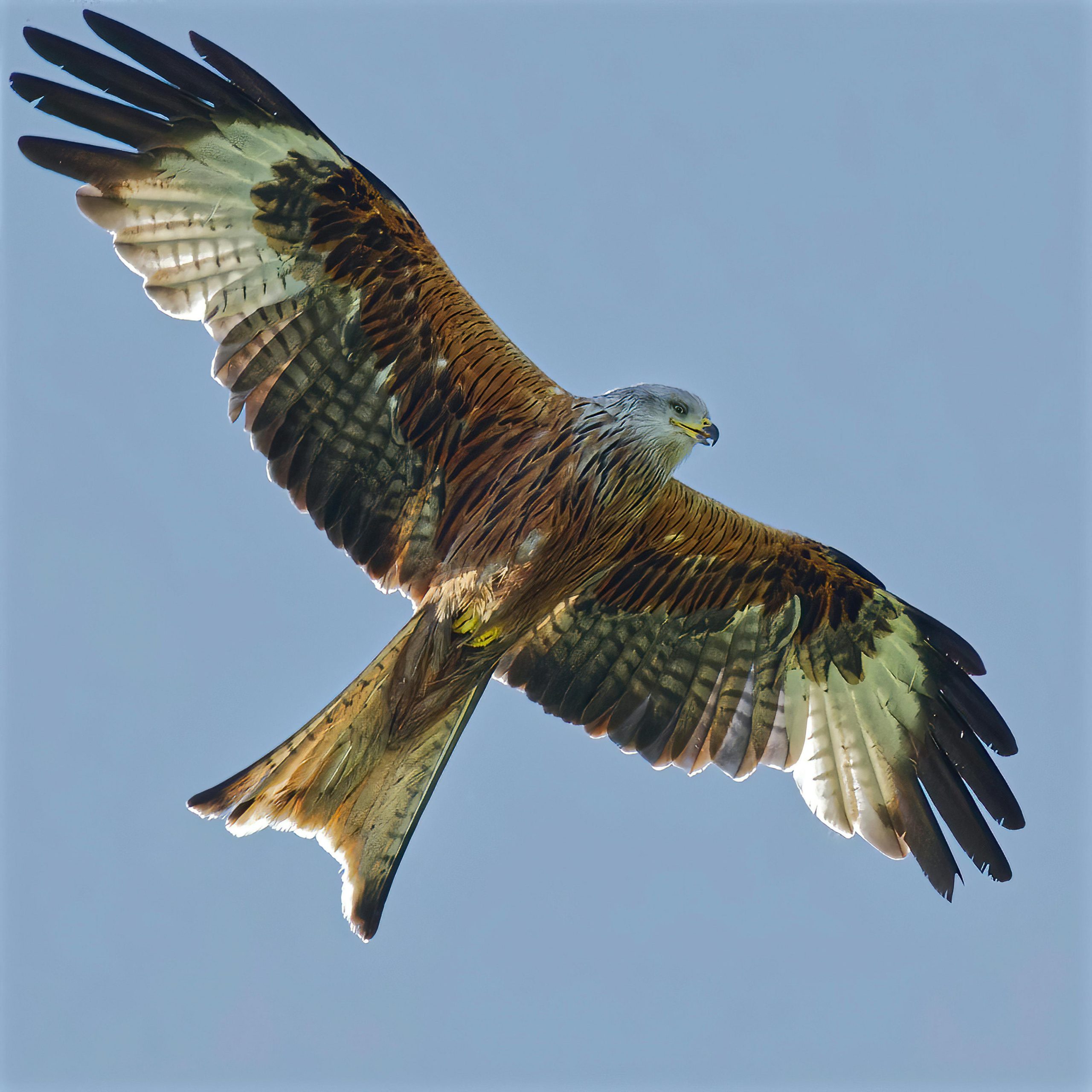
‘You can make a difference.’ That’s what I feel every time that I see a red kite. For my money, red kites are the most magnificent bird of prey that I’m likely to see in rural England.
Their reddish-brown plumage and distinctive forked tail are striking. They weigh just 1kg, but use their 6ft wingspan to good effect, seeming to soar effortlessly over the countryside, quartering the land for carrion. If I could soar, I’d want to soar like a red kite.
Putting the hens to bed recently, I watched in awe as 11 red kites soared over the garden, house and surrounding fields, gathering together as they headed for their collective winter roost. Eleven!
They were breathtaking, gliding on the thermals, seeming to hang in the air as they studied the ground for a pre-bedtime snack, supremely indifferent to my presence and more beautiful than it is possible to convey.
Magnificent avian street sweepers
Reportedly, there is a local winter roost of some 23 birds. I say ‘reportedly’ because, as a journalist, I can’t corroborate this number. But I can tell you that I’ve seen 11, and counted them repeatedly, just to be sure.
It wasn’t always like this. Back in Shakespeare’s day, red kites were part of normal life in both town and country, catching rats and scavenging bits of meat that had been discarded in the street. They were magnificent avian street sweepers.
Attitudes changed, and they became viewed as vermin themselves. Persecution followed, and by 1871, they were extinct in England, Scotland and Ireland, with just a few breeding pairs hanging on in Wales.
It makes you ashamed to be human.
But some people wanted to change all that, and my dad was one of them. He was a keen naturalist and wanted to help redeem the damage done by others. So, when the RSPB and Natural England launched a scheme to re-introduce red kites to the Chiltern Hills, where we lived, my dad signed up to help.
Young birds were brought from Sweden and Spain, where populations were more numerous, and resettled in the Chilterns.

My dad was part of the team that kept a weather eye on their nests, to prevent thefts by egg collectors, or other ne’er-do-wells attempting to kill the birds with poisoned food.
This was a legendary story in our household and is one of the ways that I remember my father, as someone who wanted to make a difference and did. Today there are an estimated 4,000 breeding pairs of red kites, and a heartwarming number of them are in the village.
It is easy to be overwhelmed by the enormity of climate change and species decline. But my father’s story, and that of the red kites, just shows that we as individuals can make a positive difference in this situation.
Elsewhere in the UK, species such as avocets, osprey, golden eagles and beavers are all being re-introduced, presumably with the determined help of people like my dad.
So, every time I see the red kites wheeling overhead as I put the hens to bed, or soaring above farmland as I’m out on a walk, I think about the potential for positive change and remind myself that all things are possible with a little effort.